Batteries lead a solitary and melancholic existence, and they can unexpectedly fail due to a number of different factors. In case your battery dies unexpectedly, you can seek assistance from a trusted technician who can inspect the battery and charging system.
However, in the meantime, what you need to figure out is how to jumpstart your vehicle.
In the following guide, we will outline the procedures for jumpstarting your car safely and avoiding electrical shocks, provide some useful tips and techniques for facilitating the process, and offer some guidance to help you prevent a dead battery from occurring altogether.
Locate Your Battery:
The first step is to locate your vehicle's battery and learn how to access it. You can consult your owner's manual for this information, or use your smartphone to search for "battery location" along with your vehicle's name on Google or YouTube to find helpful photos/videos.
Keep in mind that some vehicles may have unconventional battery placements, such as deep in the engine bay or beneath a seat. If this is the case with your vehicle, it will have remote-mounted jump-start terminals beneath the hood that are linked to the battery.
This is the part where you'll need jumper cables and a second vehicle, or you can use a portable battery powered jumper box, which is an extremely handy tool for jump-starting your car without needing a second vehicle.
Locate Your Jump Points:
Now, locate the positive and negative terminals on your dead battery. If your car’s dead battery is somewhere odd, note the location of the positive and negative terminals you tracked down in Step 1.
These terminals are connected to the battery, and hooking up to these points is the same thing as connecting to the battery itself. Always consult your owner's manual, since some vehicles can be finicky.
The primary reason for identifying the negative battery terminal is to ensure that you can distinguish it from the positive one. It is important to avoid connecting to the negative terminal of either battery and instead, use grounding points.
Grounding points refer to any conductive metal connected to the vehicle's frame, such as an exhaust manifold bolt (be cautious of heat) or engine mount bolt. It is advisable to select a grounding point that is a safe distance away from the battery. You can refer to your owner's manual for more information.
Connect The Positive Terminals:
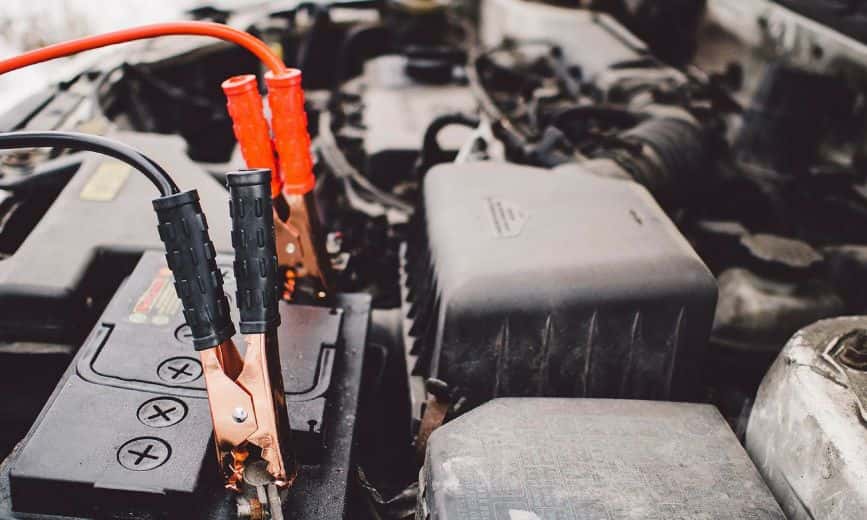
Examine your jumper cables and locate the red wires and clamps, as well as the black wires and clamps.
Attach one of the red clamps to the positive (red) terminal of the dead battery (or its corresponding connection point), ensuring a secure connection by gently wiggling the cable clamp. Once the positive connection is established, attach the other red clamp to the positive (red) terminal of the donor vehicle's battery, following the same process.
Connect The Negative Terminals:
You have two negative cable clamps that need to be connected.
Attach the negative (black) cable clamp to the negative (black) terminal of the donor vehicle's battery. After ensuring a firm connection, take the last remaining clamp and connect it cautiously to the grounding point identified in Step 2, usually located on or near the disabled vehicle's engine block.
Fire Up The Engine:
It’s time to start the engine of the donor vehicle, ensuring that its alternator is charging its battery so there’s enough juice to go around.
Next hop back into your car and start the engine. It may be slow to crank, or struggle. If it takes several tries to crank over your engine, be sure to avoid overheating the starter motor, which can cause permanent damage.
Disconnect The Cables:
Finally, remove all cables in the reverse order from above. Close your vehicle’s hood, but keep the engine running. It's best to drive your vehicle around for 15-20 minutes to ensure the battery is charging. You can also consider taking the vehicle to a mechanic shop, like House of Cars, to see if there's a problem with the alternator, starter or faulty battery.