03-24-23

How To Jump-Start A Vehicle With Jumper Cables

Batteries lead a solitary and melancholic existence, and they can unexpectedly fail due to a number of different factors. In case your battery dies unexpectedly, you can seek assistance from a trusted technician who can inspect the battery and charging system.

However, in the meantime, what you need to figure out is how to jumpstart your vehicle.

In the following guide, we will outline the procedures for jumpstarting your car safely and avoiding electrical shocks, provide some useful tips and techniques for facilitating the process, and offer some guidance to help you prevent a dead battery from occurring altogether.

Locate Your Battery:

The first step is to locate your vehicle's battery and learn how to access it. You can consult your owner's manual for this information, or use your smartphone to search for "battery location" along with your vehicle's name on Google or YouTube to find helpful photos/videos.

Keep in mind that some vehicles may have unconventional battery placements, such as deep in the engine bay or beneath a seat. If this is the case with your vehicle, it will have remote-mounted jump-start terminals beneath the hood that are linked to the battery.

This is the part where you'll need jumper cables and a second vehicle, or you can use a portable battery powered jumper box, which is an extremely handy tool for jump-starting your car without needing a second vehicle.

Locate Your Jump Points:

Now, locate the positive and negative terminals on your dead battery. If your car’s dead battery is somewhere odd, note the location of the positive and negative terminals you tracked down in Step 1.

These terminals are connected to the battery, and hooking up to these points is the same thing as connecting to the battery itself. Always consult your owner's manual, since some vehicles can be finicky.

The primary reason for identifying the negative battery terminal is to ensure that you can distinguish it from the positive one. It is important to avoid connecting to the negative terminal of either battery and instead, use grounding points.

Grounding points refer to any conductive metal connected to the vehicle's frame, such as an exhaust manifold bolt (be cautious of heat) or engine mount bolt. It is advisable to select a grounding point that is a safe distance away from the battery. You can refer to your owner's manual for more information.

Connect The Positive Terminals:

Examine your jumper cables and locate the red wires and clamps, as well as the black wires and clamps.

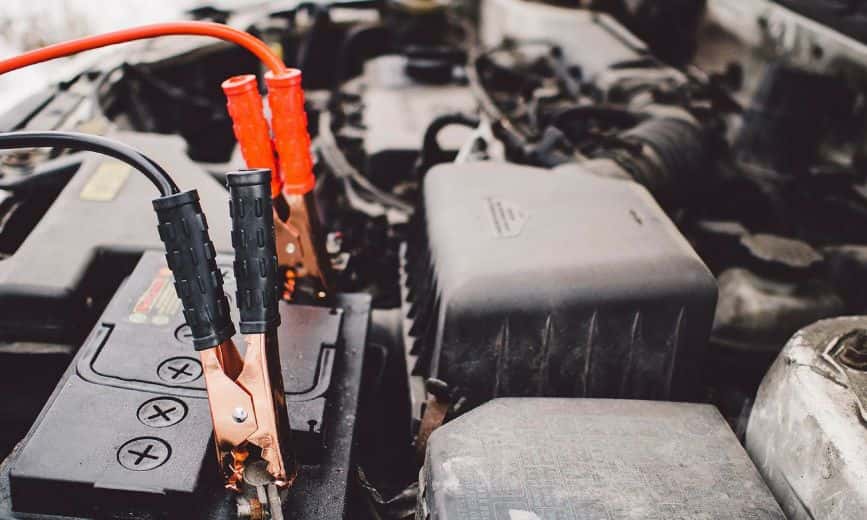
Attach one of the red clamps to the positive (red) terminal of the dead battery (or its corresponding connection point), ensuring a secure connection by gently wiggling the cable clamp. Once the positive connection is established, attach the other red clamp to the positive (red) terminal of the donor vehicle's battery, following the same process.

Connect The Negative Terminals:

You have two negative cable clamps that need to be connected.

Attach the negative (black) cable clamp to the negative (black) terminal of the donor vehicle's battery. After ensuring a firm connection, take the last remaining clamp and connect it cautiously to the grounding point identified in Step 2, usually located on or near the disabled vehicle's engine block.

Fire Up The Engine:

It’s time to start the engine of the donor vehicle, ensuring that its alternator is charging its battery so there’s enough juice to go around.

Next hop back into your car and start the engine. It may be slow to crank, or struggle. If it takes several tries to crank over your engine, be sure to avoid overheating the starter motor, which can cause permanent damage.

Disconnect The Cables:

Finally, remove all cables in the reverse order from above. Close your vehicle’s hood, but keep the engine running. It's best to drive your vehicle around for 15-20 minutes to ensure the battery is charging. You can also consider taking the vehicle to a mechanic shop, like House of Cars, to see if there's a problem with the alternator, starter or faulty battery.

Read More
CATEGORIES »
TAGS »

03-17-23

I Have A Check-Engine Light On! What Should I Do?

Cars, like many other things, are not flawless. Despite the reputation of being dependable, it's reasonable to assume that something will eventually fail or malfunction regardless of the car you purchase. Fortunately, your car's metaphorical brain can detect an imminent issue before you notice it and typically notifies you with a warning. Modern vehicles come equipped with sensors and indicators that monitor tire pressure and washer fluid levels, among other things. However, do you understand the meaning of all the dashboard symbols? If not, don't worry because we've created a comprehensive guide that covers the ten most frequently encountered warning lights in cars.

Fog Lights:

Let's begin with a dashboard light that isn't precisely a warning sign. The fog light emblem appears similar to the regular headlights symbol, except for a wavy line in front instead of three beam-like lines. Fog lights are not available in all cars, so it's plausible that you might not encounter this dashboard light while operating a vehicle.

Tire Pressure Light:

Contemporary automobiles are equipped with tire pressure monitoring systems, and the warning light that features an exclamation mark inside a semi-circle denotes that one or more of your tires have low air pressure. If this symbol illuminates, don't panic. Instead, locate a secure area to halt and inspect your tires. If they appear deflated, cautiously drive to the closest gas station to inflate them. In most cases, the warning light will turn off automatically after filling the tires with air.

Engine Oil Warning Light:

For years, cars have been equipped with the ability to monitor their engine oil pressure. If a dashboard light resembling a gravy boat appears, it indicates an issue with your engine oil pressure. Inadequate oil pressure can prevent the engine from lubricating itself correctly, which may result in significant mechanical complications such as engine seizing and leaving you stuck. Therefore, it's extremely important to get this problem examined promptly.

Check Engine Light:

The dreaded check engine light is something you never want to see on your dashboard. This light indicates that one of the numerous sensors monitoring your vehicle has detected a problem with the engine. It could be anything from a defective spark plug to a major failure such as the intake manifold or low compression. Unless you're highly skilled, it's best to leave such repairs to a trusted mechanic. Regardless, if you notice the check engine light illuminated on your dashboard, it signifies a problem that requires attention, and you should not delay visiting an auto repair shop. The quicker you can address the issue, the better. Here's a list of common check engine light causes.

Traction Or Stability Control Light:

The majority of cars equipped with traction or stability control allow you to disable these features. If you notice an old sedan's rear view followed by squiggly lines on the road, it indicates that your stability control system is either partially or fully deactivated. There are two possible explanations for this: either you turned off the function to engage in some spirited driving (remember, you're not Lewis Hamilton, so turn it back on), or the feature has malfunctioned. It's advisable to allow the vehicle's computer to handle traction for you, so try to reactivate the stability control system as soon as possible for optimal safety.

Coolant Level Warning Light:

If you notice a small thermometer icon appear on your dashboard, it is likely an indication that your vehicle is experiencing overheating. Several factors could have contributed to this problem; however, the safest course of action is to pull over and allow the engine to cool down for an extended period. Once the engine has sufficiently cooled, open the hood and inspect the coolant reservoir, checking the coolant level with a rag. In the event that the engine, coolant reservoir, or coolant tank appears to be emitting smoke, you should consider contacting a tow service.

Brake System Warning Light:

If you observe an exclamation mark enclosed in a circle on your dashboard, it is an indication of a malfunction with your brake system. This could stem from an issue with brake components or require a hydraulic fluid refill. In this situation, it is imperative to immediately stop your car and contact a tow truck in a safe manner. Operating a vehicle with a faulty brake system is hazardous and should be remedied as soon as possible.

ABS Sensor Warning Light:

The ABS warning light is not an indicator of a problem with your car's physical brakes, but rather with its anti-lock brake system. If this light is on, it's possible that your car's brakes could lock up if you stop too hard, which would make it difficult to come to a complete stop. Since ABS is one of the most important safety features in modern cars, it's important to take your vehicle to a shop to have it checked out.

Airbag Warning Light:

Nowadays, it's mandatory for all cars to have airbags, and you may notice an airbag warning light on your dashboard. This light can indicate various issues such as the failure of sensors that detect crashes and deploy airbags during an accident. If this warning light appears frequently, it's crucial to take your vehicle to a trusted mechanic for a thorough inspection.

Battery Light:

When a little red battery symbol appears on your dashboard, it indicates that your car is running solely on the battery's power. Without the engine running, the alternator is not generating electricity to recharge the battery. If you continue to use electrical components like the radio or lights, the battery will eventually drain and require a jump-start to start the car again. If the battery light is illuminated while the engine is running, it could indicate that the charging system is not functioning properly. In this case, it is recommended to take your car to a mechanic to diagnose and repair the issue.

Unlock Gear Selector Light:

The green shoe is a symbol that appears inside the brake-related icon, which consists of a circle with small arcs at the three and nine o'clock positions representing brake drums and shoes. This symbol is exclusive to cars equipped with automatic transmissions and indicates that the driver must apply the brakes to release the gear selector before shifting from park mode. Once the driver steps on the brake pedal, the symbol should disappear.

Low Fuel Light:

When this light is turned on, it indicates that the fuel level in your vehicle is low and it's time to refuel. Some vehicles have a predetermined amount of fuel left in the tank before this light comes on, while others use the car's computer to predict when the fuel level will run low based on recent driving behavior and remaining fuel. In some cases, a basic light is used instead of an icon to signal the low fuel level.

Diesel Glow Plugs Active:

This particular symbol is exclusive to diesel-fueled vehicles and indicates that the glow plugs are operating. The glow plugs are responsible for heating the air in the cylinder before ignition to prevent failure to start, as the metal internals can absorb the heat from the fuel/air compression cycle. (Unlike gasoline-powered vehicles, diesel engines do not have spark plugs and depend on compression-generated heat for combustion.) Once the light goes out, you can start your vehicle. If it flashes, there could be a malfunction with the glow plug system.

What Should I Do Next?:

Read More
CATEGORIES »
TAGS »

05-31-18

Save Money On Car Repairs By Buying Your Own Used Car Parts

The average Canadian spends $100 per month on car repairs. That's over $1200 a year, assuming nothing major goes wrong with the car.

For reference, that's around equal to what the average Canadian spends on their electricity bill per month.

Put another way, that $100 dollars is one-fifth of the average Canadian's monthly car payment.

See the issue?

Imagine purchasing tires. In many parts of the country, snow tires are crucial to living through the winter.

But often they cost $1000s of dollars. That's a sunk cost built into car ownership every few years.

It's a significant expense for something that many Canadians can't live without. But car parts don't have to cost so much.

Used car parts make car ownership more affordable. With the right eye for parts, auto costs become much more manageable.

Where to Look for Used Car Parts

The first step in buying used car parts is knowing where to look. The dealership isn't cutting you any breaks, so knowing where to look makes all the difference.

Online

Looking online is the obvious first answer. Many vendors, including bidding sits, have used car parts for sale. Everything is available, from mufflers to trim parts.

However, buying online comes with a few pitfalls.

First, you can't inspect the part before you buy. Knockoff parts are common, especially for bodywork, and the seller can write anything in the product description.

Second, it's impossible to know 100 percent that the part in question fits the vehicle. Many parts are interchangeable, but some are make and model specific.

Third-Party In-person

These are Craigslist ads, neighbors, or even local vendors running their own resale business.

In the world of buying used car parts, this option is the easiest and safest, though maybe not the cheapest.

Third-parties will know the condition of their parts, their serial numbers, etc. Buyers can know they're buying what's advertised and can see the part in-person before purchase.

Junkyards

For those with a keen eye, junkyards make an excellent source of used car parts. They're cheap, in-person, and readily available.

Buying parts from the junkyard means checking them yourself for quality, compatibility, etc.

However, junkyard prices are hard to beat, and the purchasing process is in-person. They're second in terms of safety.

Protecting from Fraud

Buying the wrong, or broken, parts is the major pitfall of used car part shopping. One slip means money wasted.

Protecting from fraud is easy enough, but takes some knowledge and patience by the buyer.

Always check the part serial number and compare it to the known part number of the genuine part.

Calling the dealership is the easiest way to know the part in question is correct. They'll have the part numbers on file by year, make, and model.

Every part is different and it's almost impossible to know which part numbers correspond to which vehicle.

Even slight differences in transmission between vehicle years can change the part number in question.

Next, always ensure the part is in working order. This can mean asking for a demonstration or test with things like electronic components.

However, purely mechanical components often just need to pass the eye test. For example, rotors are rotors, unless they're rusted or scratched.

Haggling

Saving money on used parts means negotiating the price to something around fair market value (or lower).

This means knowing what the parts cost new, before going to make the purchase. Always have an idea of what you're willing to pay before making the deal.

Most third-party resellers are willing to negotiate on price, as they're probably getting the parts for a wholesale discount.

The most important question to ask when determining price revolves around mileage. The more miles the part has seen, the less it's worth.

Remember that all auto parts depreciate in value as soon as they're used. This includes everything from trim to tires.

As a rule of thumb, the closer to 100,000 miles, the less the price. Parts also quickly lose value as the mileage climbs closer to 100,000 miles.

It's probably not even worth purchasing a part that's seen around 100,000 miles unless it's rare enough that finding it elsewhere becomes a challenge.

Part Installation

Buying the used car parts is only part of the process. The rest revolves around getting them installed.

There are three avenues to explore here.

First, dealerships will install used parts. They'll probably charge the same service fee but won't add on costs associated with purchasing parts.

Off all the options this is the most expensive.

Second, local mechanics can install third-party parts without any issue. They'll also still charge a service see, but it's likely to be considerably cheaper than the dealership.

Call around to local mechanics when verifying part numbers. The ones happy to help are probably willing to cut a deal on installation costs.

Lastly, the way to save the most money with used car parts is self-installation. Those with car savvy can install their used parts for free.

It'll take time, but lack service costs. For the true DIY person this is the ultimate in keeping car costs down.

Used Parts Make Sense

When the average monthly car repair costs are one-fifth of the average monthly car payment, there's an obvious issue.

The vehicle is depreciating in value every day, while repair costs stay constant. The cost-benefit simply doesn't add up.

However, cars are an enormously important part of society, and so repair costs are something that won't go away.

Following these used car parts shopping tips will make car repair costs a thing of the past.

Knowing where to shop, what to look for, how to protect from fraud, how to haggle, and the installation options can save hundreds. (if not more) of dollars per year.

People buy used cars all the time, so why not used car parts?

If you're looking for a deal or help financing a used car, get in touch with us. Our experts have worked with people from all walks of life to make car ownership a reality.

Whatever you need, we have you covered.

Read More
CATEGORIES »
TAGS »

Contact Us:

Name:
Email:
Message: