07-27-23

Your One-Stop Mechanic Solution: Why House of Cars Is Your Trustworthy Mechanic Shop In Alberta

As vehicle owners, we all understand the importance of finding a reliable and trustworthy mechanic shop to take care of our cars. Whether it's routine maintenance or dealing with unexpected repairs, having a go-to service center can save us time, money, and stress. In Alberta, where the weather can be harsh and road conditions challenging, it becomes even more crucial to have a reliable mechanic who can ensure your vehicle is always in top-notch condition. Did you know that House of Cars stands out as the best choice for all your car service needs? We're all over Alberta, so we can help you out whenever you need us!

Expertise and Experience:
One of the most significant advantages of choosing House of Cars for your vehicle's service and repair work is our team of highly skilled and experienced mechanics. With over a decade of experience under our belts, our experts have dealt with a wide range of vehicles and mechanical issues. Whether you drive a brand-new car or an older model, you can trust that House of Cars mechanics have the knowledge and expertise to handle it with care. Our team regularly works on Jaguars and Land Rovers as well as Hondas and Chevrolets, so you can rest easy knowing your vehicle is in good hands, regardless of the make.

Comprehensive Range of Services:
From routine oil changes to complex engine diagnostics, House of Cars offers a comprehensive range of services to meet all your car's needs. Our state-of-the-art facilities are equipped with the latest tools and technology, ensuring that your vehicle receives top-notch treatment. Whether it's brake repairs, transmission servicing, or suspension work, House of Cars has got you covered. Our newly-opened Lethbridge service centre is now open and taking service bookings!

Transparent Pricing:
One common concern when dealing with mechanics is hidden costs and surprise fees. House of Cars takes pride in its transparent pricing policy. They provide detailed estimates before starting any work on your car, ensuring that you're aware of the costs upfront. This transparency builds trust and makes them a favorite among Alberta car owners.

Customer Reviews and Testimonials:
In the digital age, customer reviews play a crucial role in helping us make informed decisions. A quick online search for House of Cars will reveal a plethora of positive reviews and glowing testimonials from satisfied customers. Our commitment to providing excellent service and going the extra mile for our clients is evident in the feedback they receive.

Genuine Parts and Warranty:
Using genuine parts for your car's repairs is essential to maintain its performance and longevity. House of Cars sources parts directly from reputable manufacturers, ensuring that your vehicle gets the best-quality components. Additionally, we back our work with a warranty, giving you peace of mind knowing that your car is protected.

Exceptional Customer Service:
At House of Cars, customer satisfaction is our top priority. Our friendly and attentive staff goes above and beyond to ensure that you have a pleasant experience during every visit. From offering shuttle services to providing regular updates on your vehicle's status, they strive to make the entire process as smooth and hassle-free as possible.

Mechanic Shop Calgary

When it comes to finding a reliable mechanic shop in Alberta, House of Cars ticks all the boxes. With our team of experienced technicians, comprehensive range of services, transparent pricing, and exceptional customer service, they have earned the trust and loyalty of numerous car owners across the province. So, the next time your car needs service or repairs, consider taking it to House of Cars. Your vehicle will thank you for it, and you'll have the peace of mind knowing that your car is in the hands of experts who truly care.
Get Started With House of Cars Service:

Read More
CATEGORIES »
TAGS »

03-24-23

How To Jump-Start A Vehicle With Jumper Cables

Batteries lead a solitary and melancholic existence, and they can unexpectedly fail due to a number of different factors. In case your battery dies unexpectedly, you can seek assistance from a trusted technician who can inspect the battery and charging system.

However, in the meantime, what you need to figure out is how to jumpstart your vehicle.

In the following guide, we will outline the procedures for jumpstarting your car safely and avoiding electrical shocks, provide some useful tips and techniques for facilitating the process, and offer some guidance to help you prevent a dead battery from occurring altogether.

Locate Your Battery:

The first step is to locate your vehicle's battery and learn how to access it. You can consult your owner's manual for this information, or use your smartphone to search for "battery location" along with your vehicle's name on Google or YouTube to find helpful photos/videos.

Keep in mind that some vehicles may have unconventional battery placements, such as deep in the engine bay or beneath a seat. If this is the case with your vehicle, it will have remote-mounted jump-start terminals beneath the hood that are linked to the battery.

This is the part where you'll need jumper cables and a second vehicle, or you can use a portable battery powered jumper box, which is an extremely handy tool for jump-starting your car without needing a second vehicle.

Locate Your Jump Points:

Now, locate the positive and negative terminals on your dead battery. If your car’s dead battery is somewhere odd, note the location of the positive and negative terminals you tracked down in Step 1.

These terminals are connected to the battery, and hooking up to these points is the same thing as connecting to the battery itself. Always consult your owner's manual, since some vehicles can be finicky.

The primary reason for identifying the negative battery terminal is to ensure that you can distinguish it from the positive one. It is important to avoid connecting to the negative terminal of either battery and instead, use grounding points.

Grounding points refer to any conductive metal connected to the vehicle's frame, such as an exhaust manifold bolt (be cautious of heat) or engine mount bolt. It is advisable to select a grounding point that is a safe distance away from the battery. You can refer to your owner's manual for more information.

Connect The Positive Terminals:

Examine your jumper cables and locate the red wires and clamps, as well as the black wires and clamps.

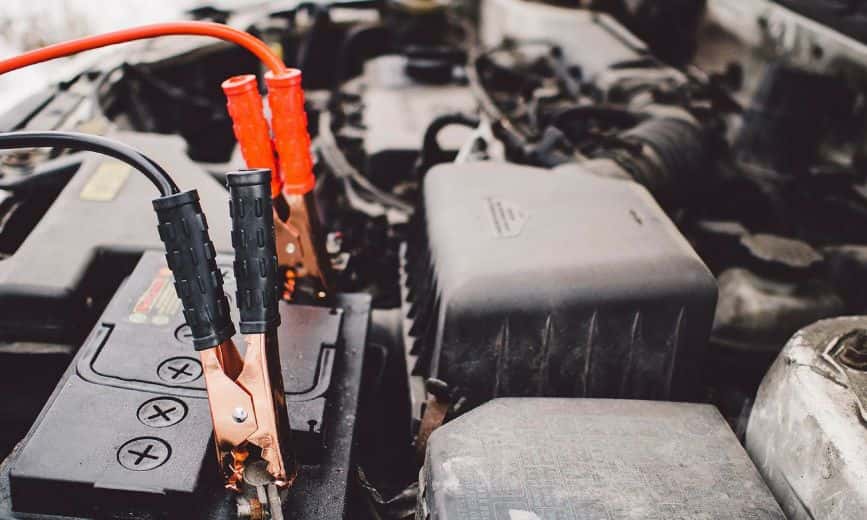
Attach one of the red clamps to the positive (red) terminal of the dead battery (or its corresponding connection point), ensuring a secure connection by gently wiggling the cable clamp. Once the positive connection is established, attach the other red clamp to the positive (red) terminal of the donor vehicle's battery, following the same process.

Connect The Negative Terminals:

You have two negative cable clamps that need to be connected.

Attach the negative (black) cable clamp to the negative (black) terminal of the donor vehicle's battery. After ensuring a firm connection, take the last remaining clamp and connect it cautiously to the grounding point identified in Step 2, usually located on or near the disabled vehicle's engine block.

Fire Up The Engine:

It’s time to start the engine of the donor vehicle, ensuring that its alternator is charging its battery so there’s enough juice to go around.

Next hop back into your car and start the engine. It may be slow to crank, or struggle. If it takes several tries to crank over your engine, be sure to avoid overheating the starter motor, which can cause permanent damage.

Disconnect The Cables:

Finally, remove all cables in the reverse order from above. Close your vehicle’s hood, but keep the engine running. It's best to drive your vehicle around for 15-20 minutes to ensure the battery is charging. You can also consider taking the vehicle to a mechanic shop, like House of Cars, to see if there's a problem with the alternator, starter or faulty battery.

Read More
CATEGORIES »
TAGS »

03-17-23

I Have A Check-Engine Light On! What Should I Do?

Cars, like many other things, are not flawless. Despite the reputation of being dependable, it's reasonable to assume that something will eventually fail or malfunction regardless of the car you purchase. Fortunately, your car's metaphorical brain can detect an imminent issue before you notice it and typically notifies you with a warning. Modern vehicles come equipped with sensors and indicators that monitor tire pressure and washer fluid levels, among other things. However, do you understand the meaning of all the dashboard symbols? If not, don't worry because we've created a comprehensive guide that covers the ten most frequently encountered warning lights in cars.

Fog Lights:

Let's begin with a dashboard light that isn't precisely a warning sign. The fog light emblem appears similar to the regular headlights symbol, except for a wavy line in front instead of three beam-like lines. Fog lights are not available in all cars, so it's plausible that you might not encounter this dashboard light while operating a vehicle.

Tire Pressure Light:

Contemporary automobiles are equipped with tire pressure monitoring systems, and the warning light that features an exclamation mark inside a semi-circle denotes that one or more of your tires have low air pressure. If this symbol illuminates, don't panic. Instead, locate a secure area to halt and inspect your tires. If they appear deflated, cautiously drive to the closest gas station to inflate them. In most cases, the warning light will turn off automatically after filling the tires with air.

Engine Oil Warning Light:

For years, cars have been equipped with the ability to monitor their engine oil pressure. If a dashboard light resembling a gravy boat appears, it indicates an issue with your engine oil pressure. Inadequate oil pressure can prevent the engine from lubricating itself correctly, which may result in significant mechanical complications such as engine seizing and leaving you stuck. Therefore, it's extremely important to get this problem examined promptly.

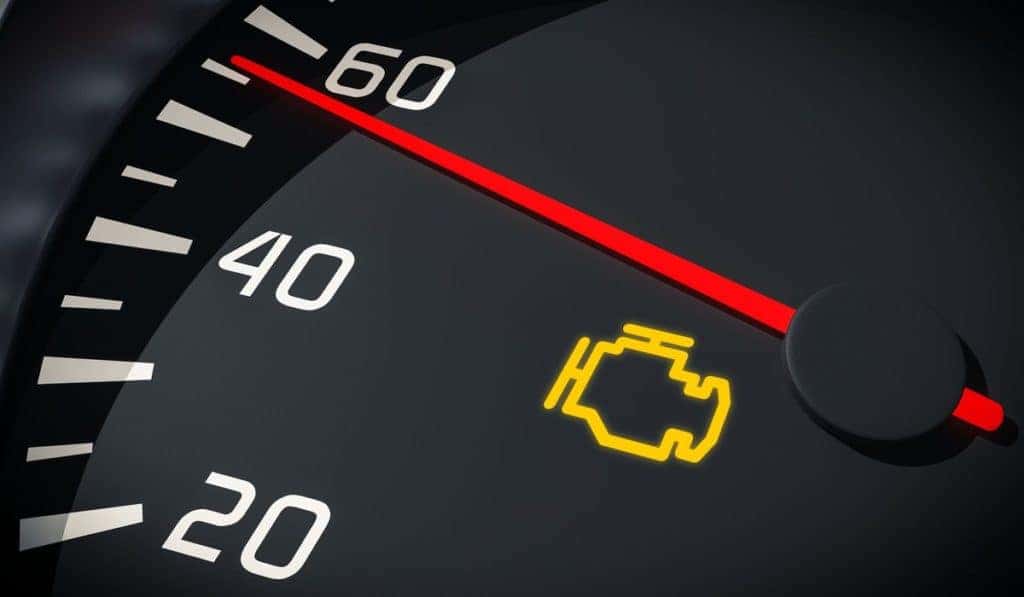
Check Engine Light:

The dreaded check engine light is something you never want to see on your dashboard. This light indicates that one of the numerous sensors monitoring your vehicle has detected a problem with the engine. It could be anything from a defective spark plug to a major failure such as the intake manifold or low compression. Unless you're highly skilled, it's best to leave such repairs to a trusted mechanic. Regardless, if you notice the check engine light illuminated on your dashboard, it signifies a problem that requires attention, and you should not delay visiting an auto repair shop. The quicker you can address the issue, the better. Here's a list of common check engine light causes.

Traction Or Stability Control Light:

The majority of cars equipped with traction or stability control allow you to disable these features. If you notice an old sedan's rear view followed by squiggly lines on the road, it indicates that your stability control system is either partially or fully deactivated. There are two possible explanations for this: either you turned off the function to engage in some spirited driving (remember, you're not Lewis Hamilton, so turn it back on), or the feature has malfunctioned. It's advisable to allow the vehicle's computer to handle traction for you, so try to reactivate the stability control system as soon as possible for optimal safety.

Coolant Level Warning Light:

If you notice a small thermometer icon appear on your dashboard, it is likely an indication that your vehicle is experiencing overheating. Several factors could have contributed to this problem; however, the safest course of action is to pull over and allow the engine to cool down for an extended period. Once the engine has sufficiently cooled, open the hood and inspect the coolant reservoir, checking the coolant level with a rag. In the event that the engine, coolant reservoir, or coolant tank appears to be emitting smoke, you should consider contacting a tow service.

Brake System Warning Light:

If you observe an exclamation mark enclosed in a circle on your dashboard, it is an indication of a malfunction with your brake system. This could stem from an issue with brake components or require a hydraulic fluid refill. In this situation, it is imperative to immediately stop your car and contact a tow truck in a safe manner. Operating a vehicle with a faulty brake system is hazardous and should be remedied as soon as possible.

ABS Sensor Warning Light:

The ABS warning light is not an indicator of a problem with your car's physical brakes, but rather with its anti-lock brake system. If this light is on, it's possible that your car's brakes could lock up if you stop too hard, which would make it difficult to come to a complete stop. Since ABS is one of the most important safety features in modern cars, it's important to take your vehicle to a shop to have it checked out.

Airbag Warning Light:

Nowadays, it's mandatory for all cars to have airbags, and you may notice an airbag warning light on your dashboard. This light can indicate various issues such as the failure of sensors that detect crashes and deploy airbags during an accident. If this warning light appears frequently, it's crucial to take your vehicle to a trusted mechanic for a thorough inspection.

Battery Light:

When a little red battery symbol appears on your dashboard, it indicates that your car is running solely on the battery's power. Without the engine running, the alternator is not generating electricity to recharge the battery. If you continue to use electrical components like the radio or lights, the battery will eventually drain and require a jump-start to start the car again. If the battery light is illuminated while the engine is running, it could indicate that the charging system is not functioning properly. In this case, it is recommended to take your car to a mechanic to diagnose and repair the issue.

Unlock Gear Selector Light:

The green shoe is a symbol that appears inside the brake-related icon, which consists of a circle with small arcs at the three and nine o'clock positions representing brake drums and shoes. This symbol is exclusive to cars equipped with automatic transmissions and indicates that the driver must apply the brakes to release the gear selector before shifting from park mode. Once the driver steps on the brake pedal, the symbol should disappear.

Low Fuel Light:

When this light is turned on, it indicates that the fuel level in your vehicle is low and it's time to refuel. Some vehicles have a predetermined amount of fuel left in the tank before this light comes on, while others use the car's computer to predict when the fuel level will run low based on recent driving behavior and remaining fuel. In some cases, a basic light is used instead of an icon to signal the low fuel level.

Diesel Glow Plugs Active:

This particular symbol is exclusive to diesel-fueled vehicles and indicates that the glow plugs are operating. The glow plugs are responsible for heating the air in the cylinder before ignition to prevent failure to start, as the metal internals can absorb the heat from the fuel/air compression cycle. (Unlike gasoline-powered vehicles, diesel engines do not have spark plugs and depend on compression-generated heat for combustion.) Once the light goes out, you can start your vehicle. If it flashes, there could be a malfunction with the glow plug system.

What Should I Do Next?:

Read More
CATEGORIES »
TAGS »

03-07-23

Why Is My Check Engine Light is On & What Should I Do About It?

While your car’s instrument cluster may have multiple lights, the one that catches your attention is typically the one you don’t want to see - the check engine light. Though you may go an extended period without seeing it, once it illuminates, it's essential to take action.

The check engine light can activate for various reasons, serving as an indication that something is amiss, but without additional information. Ignoring it can pose a danger to both you and your vehicle. However, a lit check engine light doesn't always imply an urgent threat. It could be as simple as a loose gas cap, but it's crucial to investigate and confirm that the issue is not severe or pressing.

What Do Check Engine Light Colours or Actions Mean?

The colour of the check engine light can vary and may not always be the same. It can display in red, orange, or yellow, depending on the vehicle. In certain cars, a red check engine light indicates a severe problem that warrants immediate attention, and you may need to have your car towed.

Alternatively, some vehicles use a blinking check engine light to indicate the same level of severity. While solid orange or yellow lights are less severe, it's still important to have them examined to determine the cause.

One of the typical causes for the check engine light to illuminate is a loose fuel tank cap. You'll know if this is the case if the light appears right after you've filled up at a gas station. Checking the cap should be your initial step, as it's a straightforward task that doesn't necessitate technical expertise. If the cap is damaged or not functioning correctly, replacing it is inexpensive and can be done quickly by any mechanic.

Alternatively, the check engine light could relate to specific components under the hood. Here are some of the most frequent check engine warnings:

Oxygen Sensor (or O2 sensor)

The oxygen sensor gauges the amount of fuel consumed by the vehicle. Typically, cars have two to four oxygen sensors, and if any of them are faulty, it can activate the engine light. A defective sensor can lead to reduced gas mileage and increased emissions. If left unaddressed, it can cause harm to the catalytic converter, which is a costly repair with a minimum expense of $1,200. On the other hand, replacing the oxygen sensor is a less invasive repair, and it has an average cost of $260, which could be a do-it-yourself job.

Catalytic Converter Failure

The catalytic converter has a significant function in the car's exhaust system as it transforms the carbon monoxide emitted by the engine into carbon dioxide. While it's not a complex component, repairing it can be costly, making it essential to maintain. Consistent oil changes can aid in its proper operation. Other components, such as faulty oxygen sensors or spark plugs, can impact the converter's functionality. Catalytic Converter theft is a big problem in Alberta, and if your catalytic converter is missing, that could be why you're seeing a check engine light.

Spark Plug or Ignition Coil Failure

The ignition coils produce the electrical charge that the spark plugs employ to ignite the engine's cylinders. Therefore, any malfunction during this process may activate the engine light. It's crucial to keep in mind that diesel engines don't have coils or spark plugs, making this problem exclusive to gasoline-run vehicles.

If your car is slow to accelerate, worn-out spark plugs may be the culprit. However, defective ignition coils can lead to similar issues, so if you suspect that the spark plugs are the problem, it's possible that the ignition coil is also responsible.

Mass Airflow Sensor Failure

The mass airflow sensor performs two critical functions: monitoring the amount of air entering the engine and relaying this information to the car's computer to determine the proper fuel input. If it begins to malfunction, it can lead to increased emissions or even engine stalling.

One of the primary reasons for this issue is the air filter. If the filter is not installed correctly or hasn't been replaced, it can cause blockages that disrupt airflow, leading to sensor failure. Substituting the mass airflow sensor is a relatively costly repair, amounting to roughly $400. Still, you can prevent it by replacing the filter regularly.

Replace the thermostat

Similar to a standard household thermostat, the engine thermostat controls the flow of coolant. However, unlike a typical thermostat, it manages the coolant flow to the engine. If dirt or other materials contaminate the coolant, it can become corrosive, leading to an overheated engine.

While not the same problem, a coolant leak can also trigger the engine light when the engine temperature rises too much. Detecting a leak is easier since greenish drops or puddles will appear after the car has been parked for an extended period.

Replace Exhaust Gas Recirculation (EGR) Valve & Clean All EGR Ports

The EGR valve helps regulate the level of nitrogen oxide emitted from the car's engine by redirecting exhaust gas back into the combustion chambers to lower its temperature. In modern cars, the valve is electronically controlled by the onboard computer, and any issues with the flow could cause the engine light to turn on.

A buildup of carbon can cause the valve to become stuck and clog the system, which may be noticeable through visual inspection under the hood or a stall or hiccup while idling. Cleaning the valve is possible, but it may not be easily accessible in every car. If the buildup is significant, replacing the valve and a new gasket can cost approximately $500, depending on parts and labor.

If you have a check-engine light and need a diagnosis, our service department can help you out!

What Should I Do Next?:

Read More
CATEGORIES »
TAGS »

02-21-22

Car Warranty Guide: Everything Beginners Need to Know

A car warranty is essentially a repair contract limiting a car owner’s financial risk for a set period.

That contract says that your car’s manufacturer, or the company you bought an extended warranty from, will pay for some repairs of your vehicle.

Having a car warranty can help you find peace of mind even on a day it’s not needed because it can protect you from paying out-of-pocket fees if your car needs repairs.

However, it’s best to keep in mind that not all warranties are set up the same.

What does it cover?

Car manufacturers, dealerships and warranty companies offer different warranties for your vehicle’s powertrain. The powertrain includes things like your engine and transmission and a more basic parts list.

You must read through your warranty. See what items are included in the car warranties you are considering. Things like your battery, clutch or brake pads are often not included.

A car warranty covers defects or damage during everyday use and can’t be considered normal wear and tear. It pays to replace defective parts with new or reconditioned parts at the company’s discretion behind the warranty.

Usually, it also covers labour.

How long does it last?

Whether you are buying new or used, arguably the most important part of your warranty is how long it lasts.

Often, your warranty will be quoted with a length of time and a mileage. For example, a “3-year/36,000 mile warranty” means that you are covered for three years from the date of purchase or 36,000 miles, whichever comes first.

If you are driving the average or more, your warranty will end a lot faster than three years.

Pros Of Car Warranties

Cost Saving

The truth is that some car warranty plans are less expensive than others. However, it’s essential to look around and find the best deal for your finances.

This means that a driver's warranty cost may be cheaper than buying a new vehicle. This is a significant consideration for many drivers when deciding if they can afford a new car.

Less Worry

It isn’t easy to find someone who does not need peace of mind while driving a vehicle. No one can afford to take any risks while traveling, and hence it is necessary to be sure that your car is safe in the hands of the owner or driver.

One of the best ways to have peace of mind while driving is to buy a car warranty from a reputable company.

Hence, no matter the car you have, it will still be protected from any unforeseen accident. It also gives you a sense of security, which is very important while on the road.

You will know that your car is in good hands and that no unseen accidents have occurred during the journey.

Comprehensive Coverage

Comprehensive coverage goes well beyond liability insurance, and it may also include the damage done to your vehicle and damage done to another car. Not only for accidents but from all sorts of natural disasters.

Comprehensive coverage is designed to protect you in case of accidents. If, for example, you are driving along and happen to hit a pothole in the road, the insurance company will cover all damages.

While this might seem like a good thing on its own, there are some circumstances where this kind of coverage might prove to be helpful.

“Cons” of car warranties

Not all repairs are covered

Routine wear and tear, including tires, may not be part of the deal, so check carefully to see what is and isn’t covered.

Make sure you see the warranty’s “exclusion list.” This will clearly show what is not covered under warranty. Reviewing this list will help you make an informed decision and prevent unpleasant future surprises.

A savings account may make more sense

If you don’t want to take that risk, you might consider saving up your own money to cover repairs in the future, and it only covers repairs listed in the contract.

The best advice always comes from an expert

If you live in Alberta and are looking for the best pre-owned cars, don’t hesitate to look at House of Cars Calgary. We are one of the best used cars dealers in Calgary!

Buying a car warranty is not just about the price of the coverage, but the saving on your future repairs without having to pay for them out of your pocket. If you do your homework and compare different plans, you can save a lot of money.

While still receiving the type of coverage that will help you through those rough times in the future, you should also check into your existing factory warranty to determine if you are entitled to receiving repairs costs without a rebate.

Even if you are still indecisive about whether to contract a car warranty or not, make sure to get in contact with our experts so they can help you find the best option for you.

Click here to learn more!

Read More
CATEGORIES »
TAGS »

04-24-17

Think You Need New Tires? Here’s What To Look For

Once you've purchased a quality used vehicle from House of Cars, taking care of it is crucial on the Calgary roads. That not only includes routine maintenance, like oil and filter changes, but also knowing when to have worn out parts replaced. Eventually, even your tires will need replacing, and it's important to recognize the signs.

Worn Tread: Are your tires going bald? Meaning, is your tread wearing out? Worn out tread prevents your tires from being able to grip the road well, resulting in poor and unsafe handling.

Bulges and Cracks: When bulges and cracks start appearing in your tire, it could mean that something internally has broken, like a steal belt. It's best to have your tire replaced ASAP, so you don't end up with a blowout on the highway.

Vibrations: Lots of things could cause vibrations as you drive, including your tires. When tires are worn down, underinflated, damaged, or unaligned, there's a good chance you'll feel the vibration in your vehicle.

Be sure to keep an eye out for the above symptoms of damaged tires that need replacing, and keep your vehicle in top shape as you drive through Airdrie, Red Deer, and Lethbridge!

Read More
CATEGORIES »
TAGS »

Contact Us:

Name:
Email:
Message: